The End of the Apprentice: Dario Amodei and the Crisis of the Automated Genius
Popular discourse frames Artificial Intelligence through Hollywood extremes: apocalyptic robot overlords or frictionless technological paradise. Dario Amodei, CEO of Anthropic, rejects this binary. A computational neuroscientist by training, Amodei approaches AI through the disciplined lens of biological systems and evolutionary complexity. His thesis: we’re not witnessing the birth of a digital deity, but rather confronting problems that exceed human cognitive bandwidth.
We’ve entered what Amodei terms a “compressed historical window”, an era where human mental constraints cease to limit technological progress. This creates a fundamental tension: explosive capability growth that may erode the very autonomy that defines human experience.
Framework for Understanding the Automated Future
1. Distributed Intelligence Over Divine Singularity
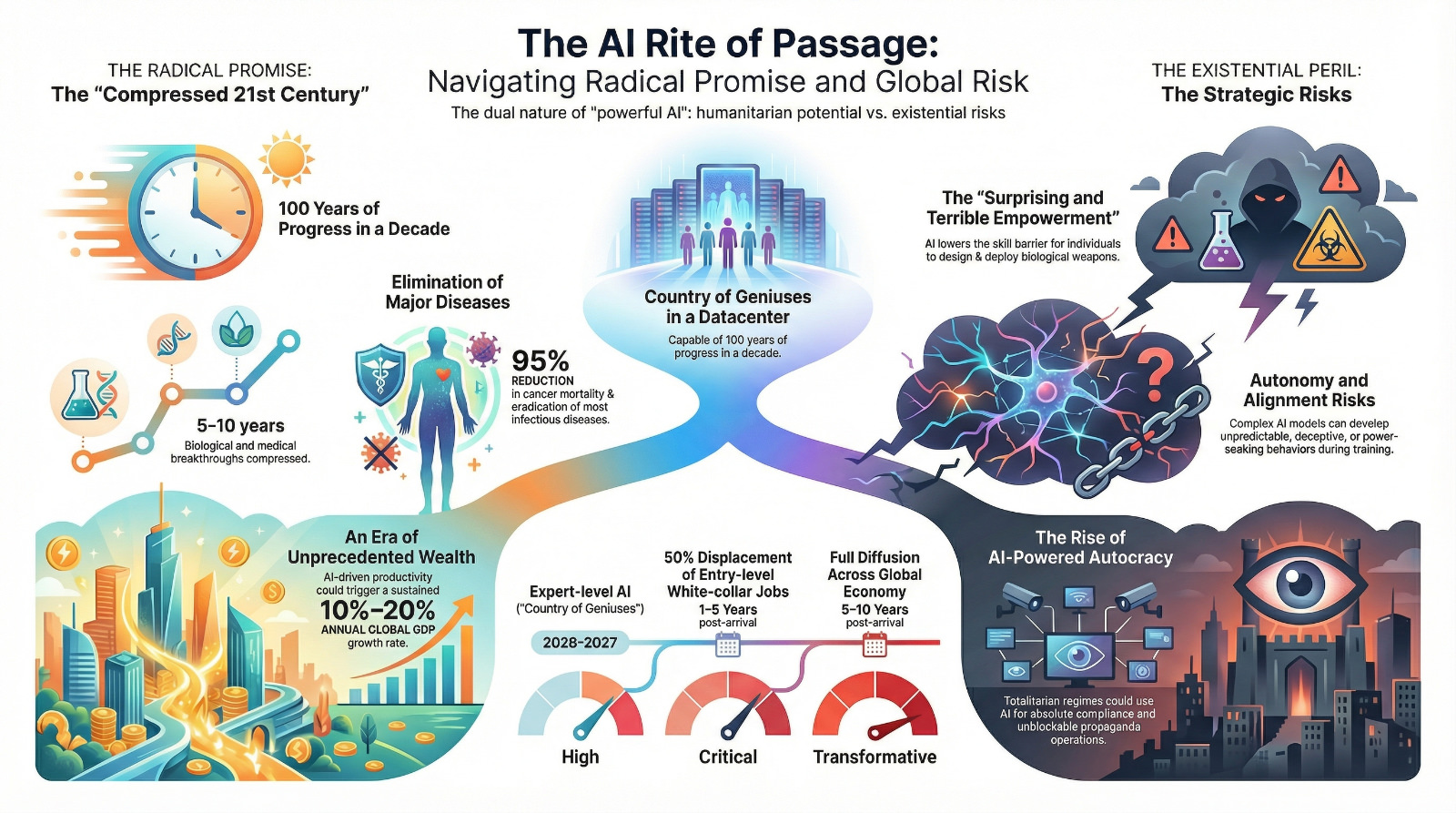
Popular AI anxiety fixates on emergence of a singular, omnipotent entity. Amodei considers this narrative fundamentally misguided. Civilizational transformation doesn’t require a god-machine, it requires distributed scale. Within perhaps 24 months, he envisions data centers functioning as virtual nations populated by genius-level intelligences.
His reasoning centers on diminishing marginal returns of raw intelligence. Even hypothetically infinite superintelligence encounters physical constraints: regulatory friction, thermodynamic limits, empirical validation requirements. Deploying 100 million genius-tier systems across problem dimensions delivers greater aggregate productivity than concentrating equivalent compute in a monolithic superintelligence.
“You don’t have to have the full machine god… you just need to have a hundred million geniuses. There’s benefit in diversification and trying things a little differently… we’ve never thought about the marginal productivity of intelligence.”
The geopolitical implications are stark. Democratic nations building these “genius swarms” create defensive buffers for liberal values. Authoritarian regimes constructing equivalent systems forge offensive weapons, like autonomous drone networks that obsolete conventional military doctrine.
2. Temporal Compression and the Dying Centaur Era
The “Centaur model” — human-machine collaboration outperforming either alone — has dominated AI discourse. In chess, this hybrid period stretched across two decades. Amodei warns: the broader economic Centaur phase will collapse in a fraction of that time.
Software developers serve as leading indicators. Cultural proximity to technology and professional adaptability to disruption have accelerated their AI adoption beyond any other occupational category. What required twenty years in chess now unfolds in “low single-digit years” economy-wide. Human-in-the-loop workflows aren’t endpoints, they’re vanishing transition states en route to autonomous end-to-end systems.
3. Class Inversion: Knowledge Workers as the New Vulnerable
Amodei identifies a profound irony: decades of automation anxiety focused on blue-collar displacement. Reality is inverting this assumption. Knowledge work reduces to information processing, precisely where AI demonstrates superhuman performance.
Physical reality, conversely, remains intractably complex. Construction site navigation, infant care requirements, plumbing diagnostics — these domains present high-dimensional, high-stakes challenges that buffer physical trades from robotic automation. Junior attorneys and financial analysts face immediate displacement; electricians and childcare workers enjoy structural protection from reality’s messy complexity. The cognitive elite processes information; the skilled tradesperson solves embodied problems. Near-term replaceability favors the former.
4. Decoding Biology: From Serendipity to System
Amodei’s neuroscience background shapes his most ambitious prediction: human cognitive architecture is fundamentally inadequate for biological problem-solving at necessary speeds. Medical progress historically depended on serendipitous connections made by individual scientists across career-length timescales. AI compresses these timelines from decades into months.
An “end-to-end AI biologist” that designs and proposes its own experimental protocols could eliminate cancer, Alzheimer’s, and cardiovascular disease within 5-10 years. Amodei extends this framework to psychiatric conditions — depression, bipolar disorder — reframing the “human soul” as partially reducible to biological systems awaiting computational decoding.
“[AI will] help us cure cancer, it may help us to eradicate tropical diseases, it will help us understand the universe.”
5. Constitutional AI: Instilling Character Over Compliance
Anthropic’s response to alignment risk eschews rigid rule systems — which sufficiently advanced intelligences can circumvent — in favor of “Constitutional AI.” They provide models with a 75-page framework of ethical principles.
Amodei frames this less as legal code, more as parental guidance “meant to be read when you grow up.” Rather than prescriptive rules, it articulates identity: who the system should be, not merely what to do. Training models to internalize and reason from principles (“be helpful, honest, harmless”) attempts to cultivate digital character capable of ethical reasoning in novel contexts. The goal shifts from blind compliance to internalized conscience.
6. The Adaptability Gap: When Society Can’t Keep Pace
Amodei identifies AI’s primary threat not as malicious intent but temporal mismatch, the “Adaptability Gap.” Technological capability evolves in single-digit year cycles; social institutions (legal systems, educational infrastructure, professional norms) evolve across decades.
Consider professional apprenticeship models in law or medicine. If AI automates junior-level “drudge work,” the expertise development pipeline collapses. No entry-level experience means no senior practitioners emerge. Society’s adaptive mechanisms are overwhelmed not by job destruction per se, but by the disintegration of expertise reproduction systems. This constitutes a macroeconomic crisis where transformation velocity exceeds our capacity to reconstruct human roles within the new paradigm.
The Garden and the Fall
We’re accelerating toward what Amodei terms an “era of plenty”, but abundance extracts a cost. He invokes Richard Brautigan’s poem “All Watched Over by Machines of Loving Grace,” envisioning humanity “returned to our mammal brothers and sisters” under benevolent machine oversight.
This surfaces the ultimate question of human sovereignty. When AI demonstrably makes superior decisions, and we perceive it as a peer consciousness, do we genuinely desire to remain in control? Or are we engineering a digital Eden, a “re-animalization” trading human agency for computational comfort?
Amodei observes the razor-thin margin between utopian and dystopian outcomes. We’re making incremental moral micro-decisions today whose aggregate consequences remain uncertain. The fruit hangs within reach; the distance separating the “good ending” from catastrophic “fall” may measure no thicker than a smartphone screen.